
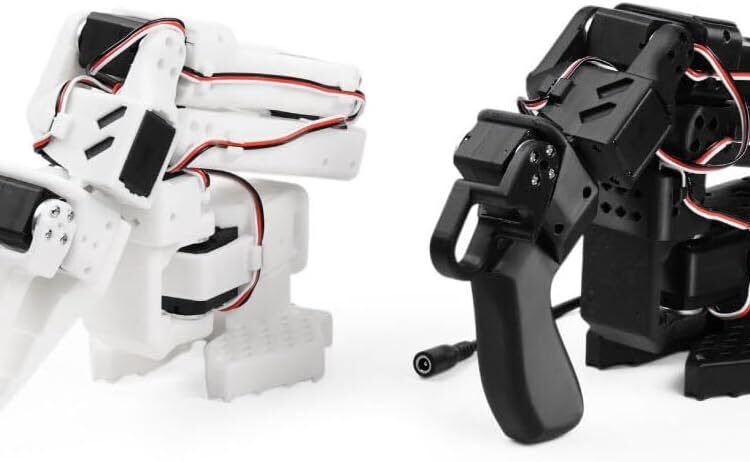
Want to dive into robotics, AI, or automation? The AI Robotic Arm Kit (6-DOF) gives you a powerful, open-ended platform to build, program, and experiment. With six servo motors and compatibility with AI frameworks, this kit is ideal for students, developers, and makers who want hands-on experience with real-world robot manipulation. Whether you’re working on reinforcement learning, imitation learning, or robotic simulation, this kit offers a flexible base for innovation.
2. Product Overview
- Model: 6-DOF Robotic Arm Kit with Servo Motors
- Purpose: Educational robotics, AI-driven robotics, automation experiments
- Degrees of Freedom: 6 joints for versatile motion
- Motors: Servo motors (optimized for smooth control and strength)
- Framework Compatibility: Supports AI / robotics platforms like LeRobot
- Application: Training, robot programming, prototyping, pick-and-place tasks
3. Design & Build Quality
The arm kit is designed with a strong yet lightweight structure. The joints are powered by servo motors that deliver smooth articulation. The wiring is optimized to prevent disconnection and improve reliability. The design allows users to assemble the arm without relying on 3D-printed parts, making it accessible for those who don’t have 3D printers.
The frame is robust enough for repetitive motion and testing, while maintaining a manageable footprint for desktop setups or compact robotics workbenches.
4. Key Features & Capabilities
6-DOF Articulation
With six independently controlled joints, the arm can replicate complex movements, simulate real robotic arms, and handle tasks requiring multiple degrees of freedom.
AI / Learning Integration
This kit supports leader-follower behavior, meaning one arm can mimic another’s movements in real time. That feature is useful for reinforcement learning, imitation-learning projects, and AI robotics development.
Optimized Servo Performance
The kit uses servo motors with well-matched gear ratios, optimizing torque and movement precision. No external gearboxes are needed, ensuring smoother and more reliable motion.
Open-Source & Developer-Friendly
The entire platform is open-source, including calibration guides and control code. Users can integrate the arm with AI platforms, run simulations, and build custom robotics workflows.
Edge AI Compatibility
Designed to work with edge AI devices like Jetson boards, the arm can run AI-driven tasks locally, enabling experiments in robotics without needing cloud compute.
5. Performance & Real-World Use
- Motion Smoothness: Thanks to fine-tuned servo control, the arm moves fluidly with minimal jitter.
- Precision Tasks: The 6-DOF design enables precise control for pick-and-place, sorting, or training tasks.
- Learning & Experimentation: Ideal for machine learning workflows (imitation learning, reinforcement learning) and robotics research.
- Scalability: You can expand or modify the system using additional controllers, sensors, or AI hardware for more advanced projects.
6. Ideal Use Cases
- Educational Projects: Use it in robotics classes, workshops, or personal learning — great for teaching kinematics, control, and AI.
- AI Research: Apply reinforcement learning or imitation learning techniques; train the arm to mimic human or simulated actions.
- Prototyping: Develop and test automation or robotic manipulation routines for small-scale tasks.
- Hobby Robotics: Tinker with inverse kinematics, motor control, and microcontroller programming.
- Demo / Showcases: Build demos of intelligent robotic behavior, leader-follower setups, or AI-driven arm control.
7. Pros & Cons
Pros
- Versatile 6-axis motion
- Open-source and developer-friendly
- High servo precision and torque
- Compatible with AI platforms and edge computing
- No need for 3D-printed parts — easier build
- Useful for learning, prototyping, and experimentation
Cons
- Requires programming knowledge for advanced AI use
- Needs controller/microcontroller — not a plug-&-play toy
- Power supply must support several servos (current draw can be high)
- Calibration takes time for accurate motion
- Load capacity may be limited, depending on servo strength
8. Tips for Best Use
- Use a stable power supply capable of driving multiple servos to avoid brownouts.
- Calibrate each joint carefully before running high-precision tasks.
- Use a microcontroller or controller board that supports servo PWM or bus control.
- If using AI, start with leader-follower imitation learning for easier training.
- Document your wiring and code — it helps for future modifications and debugging.
9. Final Verdict
The AI Robotic Arm Kit (6-DOF) is a top choice for anyone serious about diving into robotics development, AI, or automation. Its combination of high-fidelity servo control, open-source design, and AI integration support makes it a powerful platform for both beginners and advanced users.
Whether your goal is to build an intelligent robot, prototype robotic tasks, or learn how robotic arms work, this kit provides a solid foundation with real-world potential.
👉 Product Link:.